Per- and polyfluoroalkyl substances (PFAS) are chemicals containing carbon-fluorine bonds which are very strong and confer these substances various interesting properties (e.g. as antibacterial, stain/water/oil-proofing or lubricant) used in many industrial and commercial products (from electric vehicle batteries to dental floss) . The strength of the C — F bond means that these substances are persistent in the environment . This is why they are often coined as forever chemicals. The most well-known PFAS are perfluorooctanoic acid (PFOA), perfluorooctanesulfonic acid (PFOS) and perfluorohexanesulfonic acid (PFHxS), which are notably used in the manufacture of Teflon (polytetrafluoroethylene, PTFE, a fluoropolymers), Scotch guard or some fire-fighting foams. They were discovered in relation to the development of the atomic bomb in the 1930’s and served the purpose of withholding the highly corrosive uranium hexafluoride . Since then, they have been commercialised in many applications . In addition to their persistence, most PFAS are problematic for human and animal health, some have been shown to be neurotoxics and immunotoxics, and act as endocrine disruptors .
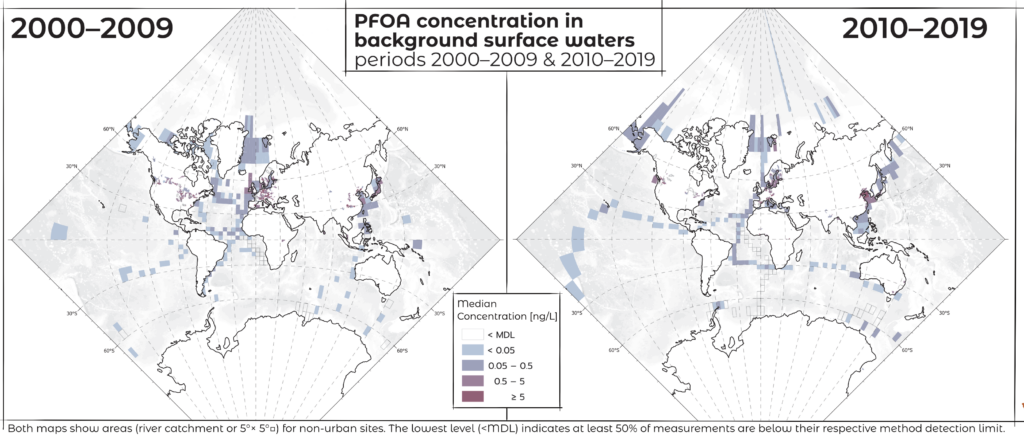
PFAS have been widely detected in global surface waters since the early 2000s . The map below shows the spatial distribution of PFOA in global waters from the review of over 200 peer-reviewed articles and governmental data on on PFAS in background surface waters (that is measurement sites far from known sources, e.g. industrial sites, waste water treatment plants outlets or polluted sites). It shows that PFAS are found even far from production and consumption sites. Generally, PFOA and PFOS concentration in background water have declined slightly from the period 2000–2009 to 2010–2019. This is due to the gradual phase-out of PFOA and PFOS by their global producers 3M and DuPont Chemours. Another important aspect is the lack of data in several areas of the World, in particular Africa and lower income countries in general.
The Forever Pollution project mapped measurements of PFAS in Europe, including at industrial or polluted sites (often the former implies the latter).
Apart from PFOS, PFOA, PFHxS and the polymer PTFE, there are many other PFAS, some developed to replace the three monomers just mentioned, and they cover a wide range of properties. What they all have in common is persistence due to their synthetic C — F bonds, which are very strong. The OECD defines PFAS as molecules having at least a carbon bonded to two fluorine atoms (and no hydrogen or other halogens, like chlorine, bromine or iodine) . This yields a large variety of compounds, many of which are pesticides or pharmaceuticals. Generally, bioaccumulation of PFAS (that is, if they will build-up in organisms, like in the liver or fat) is influenced by the number of fluorinated carbons connected together (the perfluorinated aliphatic chain) . The longer it is, the more dangerous.
In the early 2000’s, Robert Bilott initiated class actions with affected communities in Parkersburg, West Virginia, against PFOS and PFOA main producers : 3M and Dupont . They obtained to document illnesses due to these compounds among workers and neighbours of the chemical plants. These led to scientific evidence of the health issues caused by PFOA and PFOS. It was also discovered that DuPont had knowledge of the chemicals’ adverse effect from studies on animals, but continued to expose their employees, the neighbouring communities and the environment.
At the same time, 3M, and later DuPont, started to phase-out PFOA and PFOS, but, as other companies making fluorinated compounds, found alternatives to replace them. These alternatives were for example with shorter chains (like perfluorobutanoic acid PFBA, which has only 4 carbons) or with additional functional groups in-between the aliphatic chain (Gen-X, a compound with a perfluorinated aliphatic chain broken in two by an ether group, i.e. an oxygen atom in the middle). However, both PFBA and Gen-X seem to impact negatively human health and the environment. We know little of the numerous other alternatives (and their decomposition products) since it is a gigantic task to study them all. We know little of their health effect or actually which alternatives are in use .
Fluorinated pesticides and pharmaceuticals, which usually have just one or two perfluorinated carbons are still problematic because they have the potential to decompose to trifluoroacetic acid (TFA) which is both toxic and persistent. TFA is then found in rivers and lakes and in groundwaters. The Swiss Environmental Agency recently published a map of the presence of TFA in groundwater, and it is everywhere! (The Swiss Public Radio and Television published the same map but with the exact concentration at each sites).