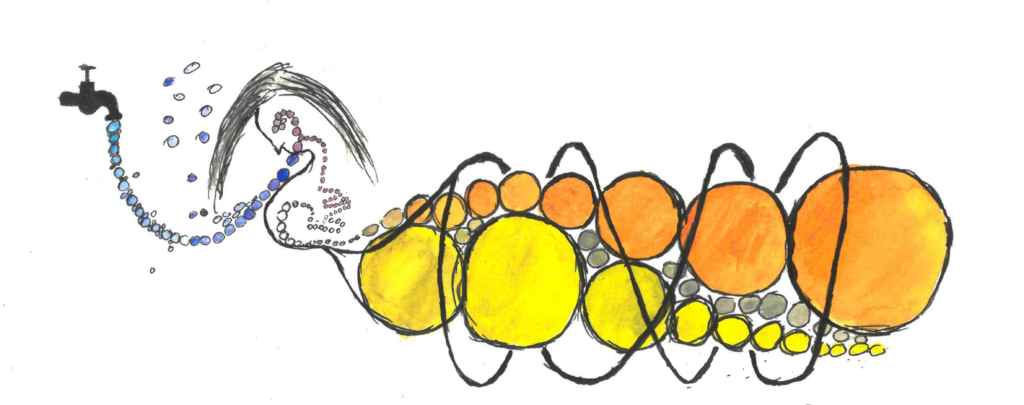
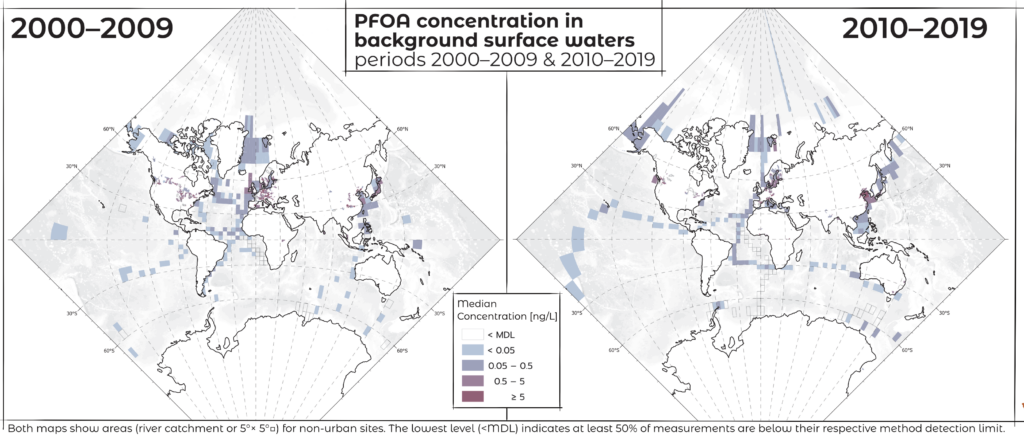
This piece rolls out some elements that make me think there is a bad risk we are introducing inadvertently large quantities of PFAS in drinking water supplies by treating it with recycled activated carbon. Activated carbon is used to remove pollutants from water and is recycled by heating at high temperatures to be further reused. This heat treatment will degrade fluoropolymers that might have been trapped, potentially leading to pollution of the drink water supply. The following text aims to expand on this hypothesis and give some supporting evidence, the thesis is nevertheless only tentative yet.
Treatment of drinking water
Drinking water supply can be contaminated by chemicals such as pesticides, pharmaceuticals or their metabolites. In Europe and the United States it is more and more common that water supplies are filtrated with activated carbon before being sent to water network in order to reduce the chemical load.
The use of pesticides and fertilisers in agriculture is an important source of drinking water pollution.
Activated carbon sourcing and recycling
The raw activated carbon is sourced from coal mines, but it is also in large part recycled. After activated carbon was used to filter water, it can be cleaned or recycled by burning at high temperatures (~900 C). At that temperature, the many contaminants are degraded to their elemental form where they are no longer a problem for drinking water. Heat-treatment is a common way of dealing with PFAS-contaminated media . Over 80% of PFOA and PFOS mineralise to elemental fluoride at temperature of 700°C and higher, and over 99.9% decompose into other organofluorine compounds Incomplete decomposition yielding shorter-chain PFAS is a concern in thermal treatment of PFAS and the risk of creating by-products is increased if required temperatures or reaction times are not precisely maintained .
Activated carbon are also effectively used to mitigate water in site polluted by PFAS or to remove PFAS from drinking water. Companies like Chemviron offer solutions to filter PFAS from contaminated sites. However, an investigative documentary by the Belgian public television RTBF showed high concentration of PFAS (637 ng/L) in ponds (which contained blackened water, indicative of the potential presence of activated carbon) neighbouring Chemviron’s industrial site. This suggests that recycling activated carbon might be a source of PFAS contamination.
After heat-treatment, the activated carbon is reused, complemented with some new raw materials to fill the losses occurring during use and recycling.
A French public TV’s documentary « Sur le front » has shown that Chemviron’s solutions are also used to treat drinking water supply, notably when there is a need to remedy a pesticide pollution, and more generally showed the wide-spread use and need of activated carbon to treat drinking water supply polluted by pesticides, especially in areas with high density of agricultural land.
Fluoropolymers
In a talk he gave when visiting our Department at Stockholm University in Autumn 2024, Professor Lee Ferguson explained the detective work he and his team did to find the source of a huge PFAS pollution in a waste water treatment plant (WWTP) in North Carolina in the United States. There were unexplained outburst of PFAS in the plant’s output that were not present in the input water. After much experimentation they found evidence that the source was the injection of burnt solid waste into the output water.
In WWTPs, solid elements are extracted from the water before chemical or bacteriological treatment of the water. In that specific WWTP, the solid waste was burnt at high temperature and the remainder was injected in the water output. The input waste water so happened to include water from textile industrial sites where fluoropolymers are largely used. It is thus though that these fluoropolymers, which are not detected as PFAS in the input water, would at least partly be burnt with solid waste which would break the fluoropolymers into PFAS monomers such as PFOA, and then be released in the WWTP output.
This could also explain the large concentration of PFAS around Chemviron’s site in ponds containing water with (possibly heat treated) activated carbon. The activated carbon would catch fluoropolymers alongside PFAS monomers when used to treat drinking water, waste water or more importantly water from PFAS contaminated sites. Then contrary to PFAS monomers which are destroyed by the heat treatment, the fluoropolymers would be degraded to PFAS monomers, at least part of which would not be destroyed.
Prof Ferguson and his team also found that this would explain high concentrations of PFAS in agricultural fields in North Carolina that were fertilised with WWTP heat-treated solid waste.
Fluoropolymers in Municipal Incinerators
We can learn about thermal treatment of activated carbon for recycling from municipal incinerators since they are operated at similar temperatures (~900°C).
In a review of the impact of fluoropolymers on human and environnemental health, Lohmann et al. discuss the persistence and disposal of fluoropolymers. Since fluoropolymers are extremely stable in the environment, they will not degrade (including in landfills) and can be a source of microplastics pollution. If they are handled in municipal incinerators, the authors note that it is yet unclear if they are fully mineralised or if they can be the source of PFAS emissions. They reference a study that investigated incineration of PTFE in a pilot municipal incinerator that burned PTFE waste at 870°C for 4 seconds. The study did not find evidence of significant degradation to PFOA (notably due to high concentrations of PFOA in their control samples, but the samples all still contained PFOA after heat treatment). In addition, they could not account for a large part of the fluorine mass balance. A later study found similar results , however both have conflicting interests as they were funded by fluoropolymer manufacturers (W.L. Gore and Gujarat Fluorochemicals GmbH respectively).
We thus need additional independent investigation in situ to get more certainty about the degradation of fluoropolymers in incinerators and in the recycling of activated carbon.
Conclusion
In light of the preceding, I think there is a risk that using recycled (heat-treated) activated carbon to filter drinking water might actually add contamination by PFAS monomers.
There might be easy solutions to this issue if it is actually there, namely not using recycled activated carbon for drinking water, but only sourcing raw materials for this specific application. Alternatively, the mechanism by which PFAS monomers remain from fluoropolymers after a heat-treatment could be further explored so that we can find complementary treatments to remove all fluoropolymers residuals.
References